You're Up Big — So Why Can't You Just Cash Out?

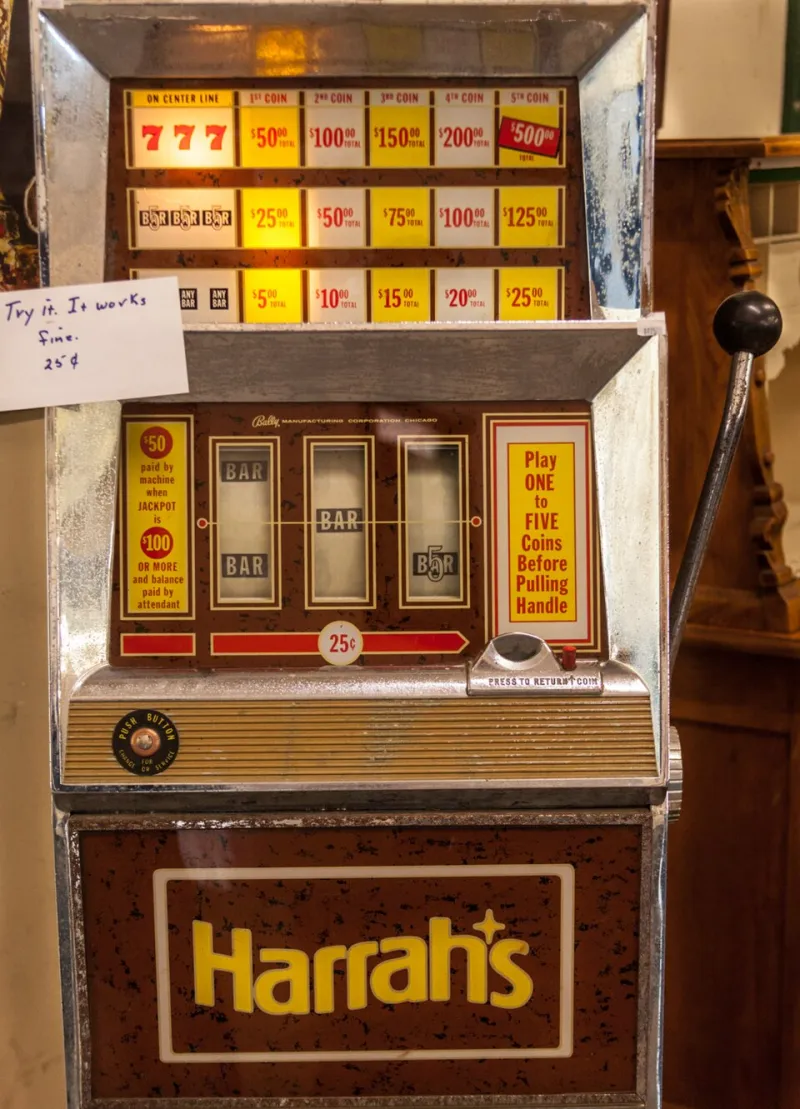
Photo: Photograph by Mike Peel (www.mikepeel.net)., CC BY-SA 4.0, via Wikimedia Commons
Picture this: you sit down with $100, hit a solid bonus round thirty minutes in, and suddenly you're staring at a $340 balance. The smart play writes itself — close the tab, withdraw, go brag to your group chat. Simple, right?
Except it never actually feels that simple.
Instead, something shifts. The win feels like momentum, like the machine is finally on your side. One more spin seems almost irresponsible not to take. And before long, you've handed back half of what you just made, maybe more.
This isn't a character flaw. It's neuroscience, behavioral economics, and slot design all colliding in your skull at once — and the deck is stacked against you in ways most players never stop to consider.
The Brain on a Hot Streak
When you land a big win, your brain doesn't just register the event and move on. It floods your system with dopamine — the same neurotransmitter tied to food, sex, and social validation. But here's the part that trips people up: dopamine isn't purely a reward signal. Research increasingly points to it as an anticipation chemical. The hit you get isn't just from winning — it's from the possibility of winning again.
That's a meaningful distinction. Once you're up, your brain doesn't say "mission accomplished." It says "imagine how good the next win could feel." The cycle doesn't close — it reopens, hungrier than before.
This is sometimes called the "winner's escalation" effect in behavioral psychology circles. A win raises your internal baseline. Suddenly, the same $340 that would've thrilled you an hour ago feels like a launching pad rather than a destination.
Loss Aversion Works Against You Here — But Backwards
You've probably heard of loss aversion — the well-documented tendency for humans to feel losses more intensely than equivalent gains. Most of the time, this makes people overly cautious. But in the context of an active winning session? It flips.
Once you've mentally "claimed" those winnings as yours, losing them back doesn't feel like losing the casino's money anymore. It feels like losing your money — money you already had. That psychological ownership kicks in fast, sometimes within minutes of a big payout.
Here's the cruel twist: that same loss aversion that should make you protect your profits instead drives you to spin more aggressively, trying to "lock in" the win through continued play. The logic doesn't hold up mathematically, but emotionally it feels airtight. You're not chasing losses — you're chasing certainty. And the reels can't give you that.
"Just One More" After a Win Hits Different
The post-win spin is its own specific trap. After a big payout, players frequently report feeling like they're playing with "house money" — a mental accounting trick where winnings feel less real than the original deposit. Because it doesn't feel like real money, the usual guardrails come down.
Researchers have a name for this: the house money effect, first described by economists Richard Thaler and Eric Johnson back in the late '80s. It's been replicated dozens of times since, and gambling contexts are one of its most consistent natural habitats.
The result? Players who would never dream of depositing an extra $200 will happily burn through $200 in winnings without a second thought — because on some subconscious level, it doesn't fully register as a real loss.
Slot Design Isn't Neutral on This
It would be convenient if this were purely an internal psychological battle, but game design plays a role too. Modern online slots are built with near-miss mechanics, escalating bonus structures, and audio-visual feedback loops that are specifically tuned to sustain engagement after big moments — not just before them.
A win triggers celebratory animations, sound bursts, and sometimes unlocks new features or multiplier modes. All of that stimulation happens right when your defenses are lowest — right when dopamine is peaking and rational calculation is at its weakest. The environment is engineered to feel like the worst possible moment to stop.
That's not a conspiracy theory. It's just smart (and effective) product design. Knowing it exists is the first step to not being fully controlled by it.
Practical Moves for Actually Locking In a Win
So what does walking away actually look like in practice? Here are a few approaches that real players use — not inspirational fluff, but actual mechanics worth building into your sessions.
Set a "victory threshold" before you start. Decide in advance what number means "I won today" — say, 2x your starting bankroll. When you hit it, the decision is already made. You're not evaluating in the moment; you're just executing a plan you made when you were thinking clearly.
Physically separate the winnings. If your platform allows it, withdraw the profit portion to your payment method immediately after hitting your threshold. What's no longer in your gaming wallet can't be spun away. Out of sight, genuinely out of reach.
Use a session timer, not just a loss limit. Most responsible gaming tools focus on loss limits, which don't help you when you're winning. A hard session timer — say, 45 minutes regardless of outcome — removes the "just a little longer" creep entirely.
Name the feeling, don't feed it. When the urge to keep spinning after a win surges, try labeling it out loud (or in your head): "This is the dopamine spike. This is the house money effect." It sounds almost laughably simple, but naming a cognitive bias interrupts its automatic grip more effectively than trying to logic your way through it.
Take the win off the table before you celebrate it. Don't linger in the game lobby after a big hit, replaying the bonus round or checking if the feature can retrigger. Log out. The celebration can happen anywhere — it doesn't need to happen at the reels.
The Real Paradox
Here's the thing nobody tells you upfront: walking away ahead isn't actually the hard part in a mechanical sense. You can close a browser tab. You can click "withdraw." The physical action takes three seconds.
The hard part is that your brain — shaped by millions of years of evolution and fine-tuned by some very talented game designers — is genuinely working against you in that moment. The impulse to keep going isn't weakness. It's biology meeting a very well-designed trigger.
Understanding that doesn't make the urge disappear. But it does change the conversation you have with yourself when you're sitting on a nice profit and the reels are still spinning in your peripheral vision.
The spin will always be there. The balance you walked away with? That's the one thing the game can't give back once it's gone.